Crossword Clues Are Lies — Here's How to Read Them Honestly
A crossword clue is a contract between the constructor and the solver. It's technically accurate, deliberately misleading, and always fair — once you know the rules.
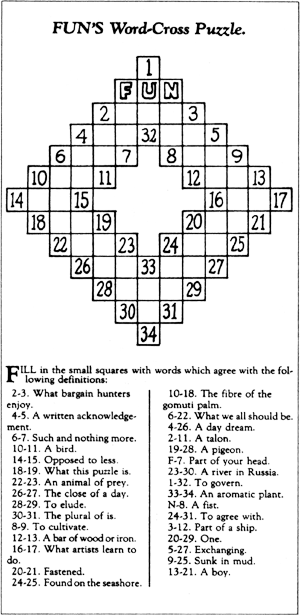
Arthur Wynne's original "Word-Cross Puzzle," New York World, December 21, 1913. Public domain.
The Contract Every Clue Honors
Arthur Wynne invented the crossword in 1913, but the clue-writing conventions that make modern crosswords both challenging and fair were codified over decades by editors like Margaret Farrar, Eugene Maleska, and Will Shortz. Every NYT clue follows rules that, once internalized, make the puzzle dramatically more approachable.
The most important rule: a clue's part of speech must match the answer's part of speech. A clue written as a noun has a noun answer. A clue ending in -ing has an -ing answer. A clue with a question mark signals wordplay. These aren't tricks — they're the terms of the contract.
The Six Types of Crossword Clues
Most crossword clues fall into one of six categories. Recognizing which type you're looking at is the first step to solving it.
What the Question Mark Means (And When to Expect It)
The question mark is the constructor's way of flagging that something unusual is happening. It signals puns, double meanings, misleading surface readings, and unconventional uses of words. Later in the week — Thursday through Saturday — question marks become more common and more devious.
Crosswordese — The Secret Language of the Grid
Every experienced solver has internalized a vocabulary of words that appear constantly in crosswords but rarely in daily conversation. These are called "crosswordese" — short words with common letter combinations that constructors use to fill awkward grid spaces.
ERNE. A sea eagle. Appears constantly. Three letters, ends in E, goes anywhere.
OREO. The cookie. Also clued as 'Nabisco product,' 'black-and-white cookie,' or 'snack since 1912.' Know it cold.
ARIA. An opera solo. Appears weekly. Four letters, alternating vowels.
ETUI. A small ornamental case for needles. You'll never use this word outside a crossword. You'll see it constantly inside one.
ALOE. The plant. Four letters, ends in E, three vowels. Constructors love it.
ESNE. An Anglo-Saxon serf. Archaic, four letters, useful to constructors. Know it.
Learning crosswordese isn't cheating — it's building the vocabulary of the game. Will Shortz has reduced the use of obscure crosswordese at the NYT, but it still appears. A solver who knows ETUI and ESNE has an advantage.
The Pattern-First Approach
Professional tournament solvers don't read every clue sequentially. They scan the grid for the longest answers first (theme entries in themed puzzles), then use crossing letters to anchor short answers. The crossing letter discipline is what separates fast solvers from slow ones.
How to Improve Faster
The research on crossword skill acquisition — covered in books like "Gridlock" by Matt Gaffney and the work of constructor Patrick Berry — consistently shows that improvement comes from doing puzzles you find slightly too hard, not ones you can breeze through. Monday NYT puzzles improve your speed; Thursday puzzles improve your pattern recognition.
The other underrated technique: after finishing a puzzle, go back and re-read every clue you got wrong and understand why the answer is right. This sounds obvious. Almost nobody does it. It's the single highest-leverage habit for improving at crosswords.
Ready to put this into practice?